Being motivated in January is easy but research shows that by February, 80% of people have abandoned their goals. Not because they’re lazy or uncommitted, but because the methods they use to get motivated don’t match how human behaviour actually works.
True motivation isn’t created by hype or “new year, new me” energy. It’s created by clarity, small wins, consistent routines and a brain that feels safe, capable and rewarded. Our guide breaks down the science behind staying motivated and how to use it to shape your strongest year yet.

1. SET GOALS: VISUALISE THE WIN (THE BRAIN NEEDS SPECIFICITY)
Vague goals like “get fitter” don’t activate your brain’s reward system, they feel overwhelming before you even start. Clear goals do. According to research published in Psychological Science, specific, measurable goals increase your likelihood of success by up to 90%.
That’s because clear goals:
- Trigger the brain’s prefrontal cortex (decision making)
- Reduce friction, confusion and hesitation
- Create a feedback loop where progress feels achievable and rewarding
Examples that work:
- “Train 3 times per week.”
- “Hit 8,000 steps daily.”
- “Increase my squat by 10kg.”
- “Stretch 10 minutes every night.”
When your brain can “see” the win, motivation follows.
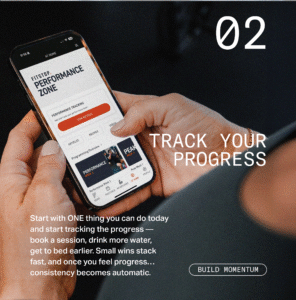
2. TRACK YOUR PROGRESS: BUILD MOMENTUM (PROGRESS = DOPAMINE)
Most people think motivation comes before action, but studies show the opposite: action creates motivation.
According to the Journal of Personality and Social Psychology, even small wins release dopamine, the chemical that makes you feel motivated, focused and optimistic. The more you see progress, the more your brain craves the behaviour that created it.
Simple things to track:
- Sessions booked
- Water intake
- Bedtime consistency
- Daily steps
These micro-wins stack fast. Research shows that people who track habits are two to three times more likely to hit their goals because they have easy access to seeing where their wins and opportunities are.
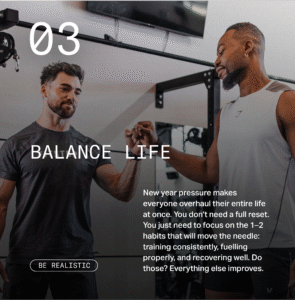
3. BALANCE LIFE: BE REALISTIC (SUSTAINABILITY BEATS INTENSITY)
Most New Year plans fail because they rely on willpower and willpower is scientifically limited. Studies from Stanford University show that willpower depletes like a battery, while habits do not.
Trying to overhaul your entire life at once leads to burnout, decision fatigue, inconsistency and guilt, which kills motivation! People who scale gradually instead of dramatically are 60% more likely to maintain their new habits past six months.
Focusing on just 1–2 high-impact behaviours creates sustainable change:
- Train consistently
- Fuel properly
- Enough sleep
- Recover intentionally
When these are in place, everything else improves: energy, mood, performance and self-efficacy.
THE BOTTOM LINE: MOTIVATION IS A SYSTEM
You don’t need a new you this year — you need a strategy that aligns with human biology and psychology.
✔ Clear goals turn intentions into actions
✔ Tracking progress rewires your brain for momentum
✔ Balanced, realistic habits create long-term success
This is how motivation becomes automatic, not something you chase but something you build. Your strongest year yet starts with clarity, compassion and a plan!

Related Articles

For a lot of people, the idea of owning a business comes with a very specific image. Early mornings. Late [...]
Walk into any high-performing gym today and you’ll notice something straight away. It’s not the equipment, it’s not even the [...]

Walk into a HYROX race hall and you’ll feel it instantly. The music is loud, the crowd is packed around [...]